
Itasca Shares New Song "Carousel" via Rookie – new album Open to Chance is out on 30 Sept
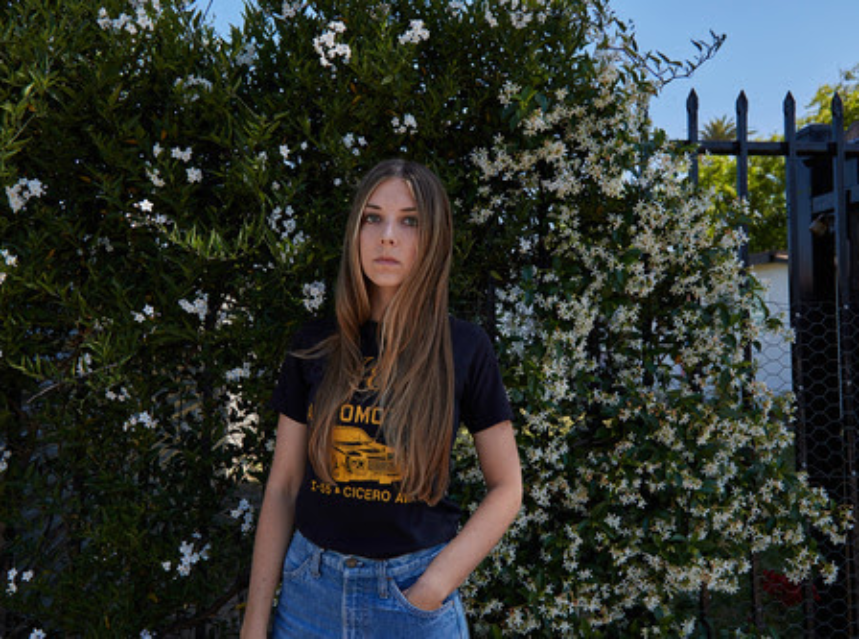
(Photo Credit: Ella Andersson)
Itasca Is L.A. Based Singer, Guitarist and Songwriter Kayla Cohen
Open To Chance is out on 30 September via Paradise of Bachelors
New Song “Carousel” Shared Via Rookie
STREAM: “Carousel”
Europe dates opening for Ryley Walker
7. November – Amsterdam, NL – Paradiso Noord
8. November – Groningen, NL – Vera
9. November – Paris, FR – Espace B
10. November – Brussels, BE – AB Club
11. November – Bruges, BE – Cactus Club
13. November – Brighton, UK – The Haunt
14. November – Manchester, UK – Ruby Lounge
15. November – Glasgow, UK – Broadcast
16. November – Birmingham, UK – Hare & Hounds
17. November – London, UK – Islington Assembly Hall
20. November – Barcelona, ES – Sidecar
21. November – Valencia, ES – Loco Club
22. November – Cadiz, ES – Aulario de la Bomba
23. November – Madrid, ES – Siroco
24. November – Vigo, ES – La Iguana
26. November – Lyon, FR – Sonic
29. November – Lausanne, CH – Le Bourg
30. November – Schorndorf, DE – Manufaktur
1. December – Erlangen, DE – E-Werk
2. December – Berlin, DE – Kantine am Berghain
4. December – Oslo, NO – John Dee
5. December – Stockholm, SE – Bryggarsalen
6. December – Copenhagen, DK – Pumpehuset
7. December – Hamburg, DE – Nochtspeicher
“Whether alone or accompanied, Cohen brings an airy but mysterious late-’60s/early-’70s psych-folk feel to the fore, and this fanciful account of alfresco domesticity certainly feels like a slice of vintage Laurel Canyon balladry.” – NPR
“The steady acoustic canter, the sighing slide guitar, the serenely idyllic images: It all suggests the balm of a gentle breeze beneath the bring sunlight, a feeling you’d want to capture indefinitely. With these three minutes, Cohen does exactly that, suspending an instant in eternal amber.” – Pitchfork on “Buddy”
Itasca, aka Southern California songwriter Kayla Cohen, has shared “Carousel,” a subtly stunning new song from her upcoming album Open To Chance. Rookie, who describe the record as “gorgeous; enchanting, mind-expanding,” premiered the track alongside a wide-ranging interview with Cohen that touches on everything from witchcraft in New York City to Black Mountain College in North Carolina. On “Carousel” Cohen trades in her guitar for piano, repeating a simple motif as waves of pedal steel wash over the scene and she sings of dissatisfaction: “Cupid’s stuck inside me now, he’s trying to get out / Open the door for me, this isn’t where I want to be, he says.”
Itasca previously shared “Buddy,” from Open To Chance, which you can stream HERE.
Itasca assets are available HERE.
Pre-order Open to Chance:
PoB: www.paradiseofbachelors.com/pob-30
Bandcamp: bit.ly/29KONyH
iTunes/Apple Music: smarturl.it/PoB30iT
Amazon Music: smarturl.it/PoB30Am

Itasca – Open To Chance
(September 30th – Paradise of Bachelors)
1. Buddy
2. Henfight
3. No Consequence
4. G.B.
5. Layman’s Banquet
6. Carousel
7. Just For Tomorrow
8. Angel
9. Daylight Under My Wing
10. Right This time
11. Bonafide
Official Site | Facebook | Twitter | Paradise of Bachelors
“As I was walking/I came upon/chance walking/the same road upon.” — Robert Creeley, “Kore” (1959)
In his 1959 poem “Kore,” Robert Creeley conjures a roadside encounter with chance, personified as a woman with dark eyes and earth in her hair, “accompanied/by goat men” and stepping in time to a “double flute.” The poem’s title historicizes the incident, cloaking it in an obscure classical ambiguity: Kore, or “maiden,” can refer either to Persephone, the mythological Greek goddess of the underworld, or generically, to ancient Greek sculptures of young women, mortal or divine, characterized by a stylized, enigmatic grin known as the “archaic smile.” This uncertainty shades the poem’s spare beauty with a stippling of sun-dappled dread; does the appearance of the lady chance, with her Mona Lisa smile and her satyrs, prefigure an occasion for love or death?
It’s fitting that Los Angeles-based guitarist, singer, and songwriter Kayla Cohen, who records and performs as Itasca, cites Creeley, and “Kore” in particular, as an influence on her enchanting, quietly assured new album Open to Chance. A hue of emergent classicism colors the stately pace and graceful carriage of these eleven understated, helical songs, suggesting both the dirt tangled in Persephone’s hair as well as the esoteric wordplay and sly musical tactics of a trickster. With Cohen’s gorgeous, moonlit voice, Open to Chancesings out an archaic smile; it poses that same inscrutable riddle of the maiden.
The idea of chance made manifest in the guise of a traveler appeals to Cohen’s symbolist songwriterly tendencies, which embrace both the arcane (her recurring, veiled references to tarot and the occult) and the quotidian (the album jacket photos were shot at the Santa Anita racetrack in Pasadena, a crucible of bad luck for gamblers). Like Creeley’s poem, Itasca’s ostensibly concrete, rustic songs—populated by chickens, mice, roses, rain, and pigpens—often pivot on a detail that reveals the limpid observational imagery in fact to be in thrall to other, sometimes unsettling forces, natural or supernatural. However, far from sounding ponderous, these juxtapositions of the everyday and the extraordinary are always subtle, even droll—winking incursions of faint magic into otherwise grounded, guitar-driven songs about a young woman’s various relationships. They also happen to reside within airy, inviting ballads—country songs in the loose, sun-shot Southern Californian sense (lots of pedal steel and space)—with melodies like arid blooms effortlessly issued from a dusty abode of adobe and tile.
“Angel” features both a “dancing Pan” and a “seedsman” with vines in his hair, a figure from the same street as Creeley’s kore. The icy solo piano number “Carousel” includes a chilling couplet that guts the modern, bourgeois notion of the five-day work week, and all that entails, with a pagan sacrificial scene: “And the weekends are filled with the act/Of dressing and toasting the death of the calf.” These are, perhaps, “the pleasures of the unknown” of which Cohen sings, but they are disconcertingly normalized in porch-friendly country-rock form, available at an altar near you come quittin’ time on Friday. The critic Harold Bloom praised John Crowley’s postmodern faerie novel Little, Big (1981) for the way it “renders domestic the marvelous”; something similar, it seems, is afoot throughout Open to Chance.
Just as the word Itasca itself is equivocal—a 19th-century pseudo-Ojibwe place name and portmanteau of the Latin words for “truth” (veritas) and “head” (caput)—so too is Cohen’s musical project mutable and multivalent: fundamentally unconcerned with genre, but richly allusive of the hermetic worlds of private-press Californian canyon-cult mystics and East Coast noiseniks alike. Tellingly, her songwriting idiom emerged gradually from her longstanding noise and drone practice. Her evocative, out-of-time recordings as Itasca—refined over the course of several releases, including the acclaimed 2014 LP Unmoored by the Wind—reflect her Janus-faced gaze towards both baroque, acid folk-inflected songcraft and deconstructive, textural sonics.
Though deeply informed by the mythology and iconography of the modern American desert West, Cohen likewise finds kinship with a lineage of English iconoclasts such as Michael Chapman and Bridget St John. Her adept, fingerstyle guitar work—nimble but unshowy, always at the service of framing her plaintively unspooling modal progressions and sonorous vocals—centers Itasca’s melancholy pastorales in a hazy, heat-mirage space equally suggestive of familiarity and distance, community and anomie. Open to Chance is her first album to feature the full band with whom she currently records and tours, including pedal steel player and frequent collaborator Dave McPeters, drummer Coleman Guyon (and occasionallyKacey Johansing), and bassist and vocalist Julia Nowak. The result is Cohen’s most accomplished, beguiling, and finely rendered record to date, the most complete invocation of the Itasca ethos.
The poem “Kore” ends with an aptly anxious question: “O love/where are you/leading/me now?” Maybe the mysterious woman on the road brings the promise of both love and death. As Cohen asks of chance in “No Consequence,” “Who is this blind god who walks with no regrets?”