
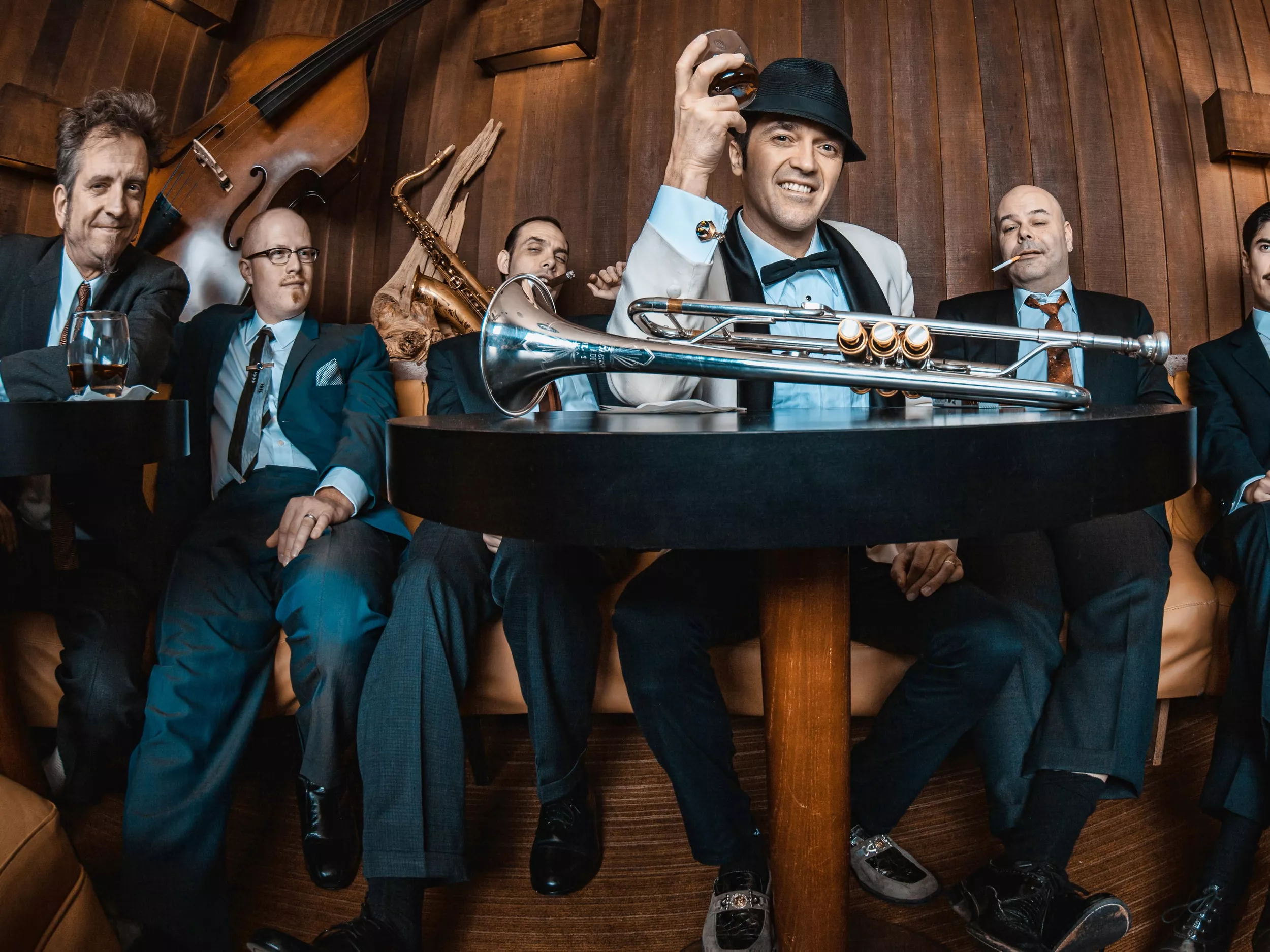
Steve Perry of the Cherry Poppin’ Daddies in conversation

If you partied like it was 1999 chances are you partied to the Cherry Poppin’ Daddies. The Daddies struck gold with compilation album “Zoot Suit Riot: The Swingin’ Hits of the Cherry Poppin’ Daddies” (1997) crowning the last few years of the Nineties with its signature big band shuck and jive.
At the core of the group is front man Steve Perry, a punk rock devotee who became enticed by ska, swing, jazz and R&B. Perry’s liberation as a songwriter has included an assortment of other styles that has made the Daddies sound tough to pigeon hole.
The band’s latest album “Bigger Life” (2019) holds on to its multi-genre roots while the words ring like a time capsule. Adding to the complexity of these extraordinary times is the personal battle of Perry’s wife, Yvette who was diagnosed with stage IV colorectal cancer in February 2018. Additionally, the Perry’s home state of Oregon was subjected to destructive, record-breaking wild fires this summer making it hazardous to even breathe.
Your correspondent reached out to Steve Perry at his home in Eugene, Oregon to check in. Perry was personable as he was gracious with his time when he responded to the questions. An edited transcript follows.
WG: What has it been like living in your city during this summer’s wildfires?
Steve Perry: Because my wife has had two lung resections this year, she’s immunocompromised. An unhealthy AQI (Air Quality Index) is like 20-something and it was 586 the other day. It was super bad. I was really worried about her and actually I felt worse than she did. My kids live right where the fire was, but thankfully their house didn’t burn down. It was scary and weird. It came to the edge of town and there was just black everywhere. It looked like a post-apocalyptic situation. A few days ago it cleared up and it rained and when it rained everyone went out on their porch, and looked up into you know the return of the “blessed.” sky. It was terrible, real bad, and because of climate change it’s likely to happen again and again out here.
How are things going for you and your wife?
Good. She’s doing real well. This year during COVID-19 she’s had 3 operations. They were all to remove metastatic tumors in her system. Right now we’re in a good place. We haven’t had a scan since her last one. She’s still taking chemo. She’s getting really good care and it’s as good as it can be. She’s a very good advocate for colon-rectal cancer too. She helps a lot of people out by virtue of her experiences. She’s had it for a few years now, she is helpful especially to people who are just starting out and they don’t know what to do and they’re terrified. Often they go to my wife and she kind of, helps them understand what they are about to go through.
https://www.gofundme.com/f/yvette-cherry-perry-cancer-fight
I’m sorry to hear about your wife. Cancer has hit our family too with my mom. My wife’s nephew is in his 20’s and he has stomach cancer.
At the same time there’s a lot of new personalized therapies and research that is going well for a lot of different cancers. There’s all sorts of theories where cancer comes from and new ways to combat it. I really think there are many breakthroughs about to happen soon and many more people are living longer. So it’s an interesting time as well.
You’re a self-taught guitarist at age 20, how did you write all these great songs?
Writing songs takes place mostly in your mind. Being a writer is different than being a good musician. It suits me to be bad at everything, but just good enough to get my idea across to someone who can sort of, get it down in a chart for other musicians. It’s hard to explain, but it’s a different set of chops, it’s an imagination thing. If you know the chords and you know what you want to say and you have conceptual ideas then it’s a different thing than being a musician who has really spent a lot of time working on their fingers and ear that way. It’s a different ear.
You were in a Paisley Underground-style band prior to Cherry Poppin’ Daddies. Did you ever see The Three O’Clock perform?
The second band I was in was a Paisley Underground-type band; it was called Saint Huck. Dan, the bass player of the Daddies and I were in the band. Dan, me and our friend Joe, who was in my first band, went down to see The Three O’Clock. I think it was Santa Rosa. We had first owned the Salvation Army record and after they changed their name to The Three O’Clock we went down to the Bay area and saw them play at some place. At some point we had Rain Parade at our band house once. We were very into the scene at that time. We had the black Beatle boots: Rain Parade, Green On Red, True West, Dream Syndicate all those bands. Around the same time we went down to see Echo and the Bunnymen at the Warfield and that show was a big influence on Saint Huck too. Saint Huck was a wide-eyed, naive band with pretentious arty ideas. It was good but way out there.
The Cherry Poppin’ Daddies are pretty diverse musically. What’s at the root of that?
Cherry Poppin Daddies at first was inspired by a desire to move an audience physically- by making body music that you could dance to. Saint Huck was so gossamer, floaty and symbolic that people would sit while watching us. That made me unsatisfied. But in some other ways Cherry Poppin Daddies was a continuation from Saint Huck of being interested in unusual ways to transmit poetic ideas. I would try to apply concepts from other forms of art and see what happened, from literature, for instance. Take “Ulysses” by James Joyce where he writes different chapters in different literary styles in what was thought of at the time as a Modernist aesthetic. He wrote a coherent narrative, but composed parts of the story in completely different novelistic styles. Growing up I was very interested in different, weird aesthetic theories like Symbolist poetry. One of the reasons I think I was into the Paisley Underground was that I kind of had a mad scientist idea to merge that style of music to my interest in Stéphane Mallarmé’s poetry to construct networks of related symbols into a poetic whole and, at least to me, it worked. So I’ve always been interested in how I could put together interesting artistic chimeras.
The Daddies diversity comes out of a number of ideas but one being that Joycean idea of multiple genres expressing a coherent narrative. The concept of an album as a deliverer of ideas abstractly as well as just a bunch of songs. I felt like the more things I could obliquely point to the more that was there for the hungry minds in the audience. Another aspect of my thinking that led to this had to do with the idea of “authenticity”. I felt very cynical about what was considered authentic and why. It was not enough for me to toil at a “brand” designed to promote ourselves to a particular audience. Rather, to attempt to make an album as a work of art that takes you on a journey. A lot of our records go from genre to genre with the hope that it kind of disrupts and challenges you as a listener and consumer. My big idea was to go against that idea of branding and “authenticity.” It kind of bugs me that someone like Bob Dylan or Bruce Springsteen are sort of known as the “authentic” artists where as somebody like David Bowie who is more of a chameleon and uses different styles is seen as somehow negative and not “authentic”. To me, that branding is a consequence of lazy minded capitalism – a fake thing. I actually see somebody like Bowie as more authentic rather than less.
I feel cynical about so called authentic acts and feel that they are unconsciously playing into easy tropes to dupe the rock critic and the audience into buying a lifestyle constructed in bad faith as opposed to selling the actual song ideas themselves. So when we’re going from thing to thing, bouncing from genre to genre, jumping around like that, people don’t like it because they don’t know where to put in you in bins of the record store. It brings about a knee jerk dislike from a lot of people. In fact, I was looking at reviews of the early Fishbone records the other day. Many critics hated them because they wouldn’t stay put in one genre or another. Reviewers liked it when they were political but they hated it when they were funny. Critics seemed determined to constrain their true fullness and humanity. It’s so lame because they are so great.
Unless you are an American cliché or you mine an area that is very small that they can break down in small bite advert portions you get marginalized by the media, but the media is just a tool of a simple minded system. My thought was “What if I can make music, an album say, in different genres? I won’t be liked, but the audience will be more likely to ask the question “why is this happening?” “Why are these songs together?” “What is going on?” I try to tie the songs together not by virtue of their genres… sometimes the genre goes contrary to what the song is about even.
Hopefully, they cohere as far as their themes and ideas and possibly a bit in a narrative sense, but they don’t necessarily cohere as far as their genre. So it’s a long way of saying I really want to be understood for what I’m trying to say as opposed to how simple I’m able to make it for the marketplace. The way you say something also has something to be said for your stance. I’m fully on the side of not having a brand or being seen as “authentic” in the Rolling Stone magazine sense.
Did the success of your album “Zoot Suit Riot” surprise you and the band?
Yes. It actually went against one of the sort of things that we were actually about. I wanted to make a fourth record and at the time we didn’t have enough money to make a full record. One thing that had been happening at our shows was that people had been asking, “which one of these records has the most swing on it.” The guy in our merchandise booth would say, “this one has two songs, this one has three, this one has four, they all have a little bit.” And he said that’s what they wanted. They would always ask which one had the most swing songs on it. We had enough money to record four songs if we were to go quickly. So we said “let’s record four songs and take all our swing songs from the previous records and put them together and we’ll see what happens.” So we recorded the song “Zoot Suit Riot”. It was a first take, that’s how little money we had. It was really something we needed to do financially in order to make our next record and at the time, things for us were moving toward swing music. That’s what people liked about our music at the time and we played it well. Ultimately, I’m happy about how it all went down. Now you can find swing music in any city, go to Beijing and there are swing societies!
What was your reaction when you heard Weird Al would do a parody of “Zoot Suit Riot” (“Grapefruit Diet”).
He called me up and we had a nice conversation. I don’t remember much about it, but I just said, “I’m flattered that you want to do it.” He didn’t tell me about what he was going to do; he said he was going to do a parody version. Especially in the late 20th century, that was a sign that you had made it when Weird Al gave you a call and wanted to parody your song.
I was reading in Wikipedia about the Cherry Poppin’ Daddies trilogy of cover albums. Is there an update about the release of the third album?
Right now in the pandemic I’ve had a chance to write a lot so there’s a lot of original music that I have. I’m probably not going to complete the trilogy next. I have three or four ideas of what the third album would be. One of the ideas I had the other day I was a Duke Ellington tribute. I have some Ellington stuff together, but I also like the idea of doing a Western swing album. It’s basically just taking some of the things that have formed our music and picking some high spots of that genre. Another idea that I have is potentially to do a beatnik jazzy style album. I’m very inspired by a lot of the be-bop vocalist type music of the late 1940’s and early 1950’s. Stuff like Slim Gaillard and Babs Gonzales. So I don’t know exactly which one I’ll do to complete the trilogy but at some point I’ll get it done.
Tell us about your current album, “Bigger Life.”
It came out last year, June 2019, and it’s kind of the “Trump years” record. I’m really happy with it, it turned out super good. It’s a record like “Susquehanna” with the over arching idea being to chart out what it was like to be alive during these last few years. Not too specifically of course. I don’t like political records that are overtly political so it’s more socio-political but to me, it worked really well. Especially, when people look back on it and then read the lyrics and go through it and listen to it in that historical context they might go, “ooh, Christ, I see what it felt like.” There’s some swing, there’s a lot of ska on it and there’s some quasi-Rockabilly-ish songs and there’s even a funky song. It’s a not a heavy record. It’s humorous at points, and it’s not a political record in the sense of telling people what to believe or anything like that. It’s more like the various things that go through your mind; there are multiple threads. There’s a lot about personally grappling with your own conscience in it.
What song should everyone hear?
The first song on “Bigger Life” is called “Diesel PunX.” It’s kind of complicated, but the idea is it’s set in the present, but I sort of envisioned proto- comic book characters in a film noir 1930’s world. I used a little bit of that and a little bit of Diesel PunX aesthetic to say something about class warfare and class-consciousness currently. There’s a video to it and you’re seeing a resistance cell in a cartoon punk novel world, and that’s the band. We shot it with a friend, Jud Turner who is an artistic sculptor and welder. The Diesel PunX go to thrift stores and buy analog tube electronics and tear them apart and make weapons so there this idea of a working-class resistance force fighting a guerrilla war with Silicon Valley digital overlords. The Diesel PunX are vacuum tube analog guys with callused hands and they are fighting the soft, evil Silicon Valley fauntleroys. Diesel PunX are “ akers” in their war. I don’t want to give it all away but that one is a good song to listen to and it kind of sets you off on this sort of “Blade Runner” world that “Bigger Life” has going on.
Where is the most interesting place a Cherry Poppin’ Daddies song has been played?
I remember during the Gulf War, we had just started out and a guy came up to me and said, “I put ‘Dr. Bones’ on when I was strafing people in the Gulf War from my cockpit.” I was like, “oh God, please don’t tell me that.”
Al Jourgensen of Ministry said front line encounters when I asked him this question. Harley Flanagan of Cro-Mags said that a Navy Seal played his music and it got him through the hardest times of his life.
“Drunk Daddy.” A lot of people who have suffered from child abuse or any sort of neglect situations write to me about that.
Can you describe a personal highlight as a member of the Cherry Poppin’ Daddies.
I remember we did a show in a blimp hanger in the Bay area, Moffett Field I think it was. It was a convention for Silicon Valley. This was when Silicon Valley was really starting. So it was everybody from every single company that now runs the world. It was Dana Carvey, Colin Powell, and the Cherry Poppin’ Daddies. Where all the money is today, they were all there. If it had blown up, this world would not have happened.